How to hang a mezuzah: where it goes, which way it tilts, and the blessing

A mezuzah goes on the right side of the doorway as you walk in, in the upper third of the doorpost. If you follow Ashkenazi custom, the top tilts toward the room. You say one blessing and then fix it in place. Below is exactly where it goes, which doors need one, how to mount it so it stays put, and why it leans.
Where does a mezuzah go on the door?
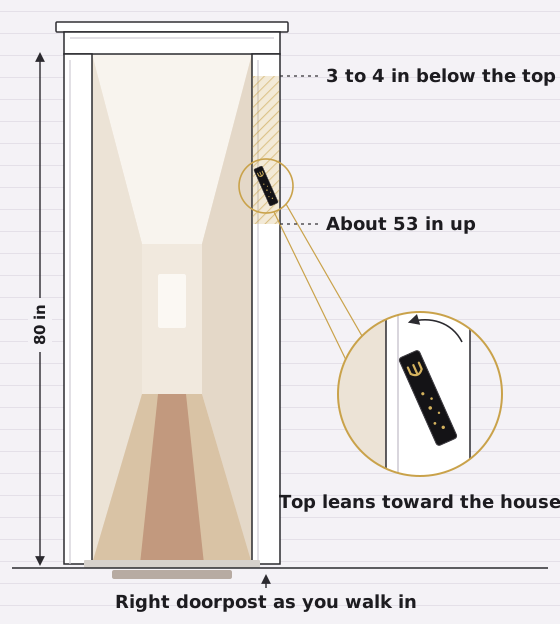
On the right doorpost as you enter, in the upper third of the doorpost. "As you enter" means the direction you walk into the house or the room, so check it for each doorway. Keep the top of the mezuzah at least a handbreadth, about 3 to 4 inches, below the top of the frame.
For a standard door frame 80 inches tall, the upper third starts about 53 inches from the floor. Anywhere from 53 inches up to 3 or 4 inches below the top works. Most people pick a spot near the bottom of that range, around shoulder height, so they can reach it.
- Front door. Stand outside facing the door. The mezuzah goes on your right.
- Inside doors. Use the direction you walk into the room. For a door between two rooms, the answer depends on which way the door swings and how the rooms are used, so that one is a question for your rabbi.
- Narrow or stone frames. If the doorpost is too narrow for the case, mount it on the wall right beside the doorway, as close to the opening as you can.
Which way should a mezuzah tilt?
In most Ashkenazi homes, the top tilts inward, toward the room you are entering, and the bottom points back out toward the street. Sephardic Jews usually hang the mezuzah straight up and down. Both are correct within their own tradition, so follow your family's.
| Tradition | Angle | Side | Height |
|---|---|---|---|
| Ashkenazi | Diagonal, top toward the inside | Right doorpost as you enter | Upper third of the doorpost |
| Sephardi | Vertical | Right doorpost as you enter | Upper third of the doorpost |
Why the mezuzah is slanted
The slant settles an argument between two medieval scholars. Rashi held that the mezuzah should stand upright. His grandson, Rabbeinu Tam, held that it should lie flat. Ashkenazi practice split the difference with a diagonal, a ruling the Rema recorded in his notes on the Shulchan Aruch, at Yoreh De'ah 289:6. Many people read the compromise itself as the lesson. A home works when both sides give a little.
Which doors in the house need a mezuzah?
Every doorway with a frame that leads into a room people live in. That includes the front and back doors, bedrooms, the kitchen and the living room. Bathrooms do not get one, and neither do small storage closets. Rented homes need them too.
If you are putting up several at once, start with the front door. A finished basement, a garage or a porch can go either way depending on how you use the space, so ask your rabbi about those.
How do you put up a mezuzah, step by step?
- Get a kosher scroll. The scroll, called a klaf, is what makes it a mezuzah. A trained scribe writes it by hand, and you buy it from a scribe or a Judaica store. Check the length fits your case. Ours take scrolls up to 12 cm, or 4.7 inches.
- Roll and protect it. Roll it from the end of the text toward the beginning, so the first word, Shema, ends up on the outside. Many people slip it into a small plastic sleeve to keep out damp.
- Put it in the case with the start of the text toward the top.
- Mark the spot on the right doorpost, in the upper third.
- Say the blessing, then fix the mezuzah in place right away without talking in between.

The blessing for hanging a mezuzah
בָּרוּךְ אַתָּה ה׳ אֱלֹהֵינוּ מֶלֶךְ הָעוֹלָם אֲשֶׁר קִדְּשָׁנוּ בְּמִצְוֹתָיו וְצִוָּנוּ לִקְבֹּעַ מְזוּזָה
Baruch atah Adonai, Eloheinu melech ha'olam, asher kid'shanu b'mitzvotav v'tzivanu likbo'a mezuzah.
Blessed are You, Lord our God, King of the universe, who has made us holy with His commandments and commanded us to affix a mezuzah.
Can you hang a mezuzah with double-sided tape?
Yes, as long as it holds firmly. Jewish law asks for a mezuzah that is fixed in place, not one that hangs loose. Mounting tape that keeps the case flat and secure meets that for most rabbis. A mezuzah dangling from a hook or a string does not. If your rabbi asks for nails or screws, follow that.
Every case we make comes with two clear self-adhesive strips on the back, so you don't need tools. That includes the wedding glass keepsake mezuzahs. To make the strips hold:
- Clean the spot first. Wipe it with rubbing alcohol and let it dry. Dust and grease are the usual reason tape lets go.
- Press hard. Hold the case flat against the frame for a good half minute.
- Skip rough or flaking surfaces. Tape grips smooth paint, wood and metal. On textured stone or peeling paint, use the smoothest patch you can find within the upper third.

Modern Mezuzah Case. Gold Shin Letter
$78.00 CAD

Modern Mezuzah Case. Silver Hamsa Hand
$100.00 CAD

Kids Modern Mezuzah Case. Antique Silver Teddy Bear and Silver Shin
$75.00 CAD
Frequently asked questions
Do I say the blessing for every mezuzah?
No. One blessing covers every mezuzah you put up in one go, as long as you have them all in mind and don't stop for other things in between. A mezuzah you hang on another day gets its own blessing.
How soon after moving in should I hang it?
If you own the home, right away. Outside Israel, tradition gives renters up to 30 days, but plenty of people put the front door mezuzah up on moving day.
What do I do with my mezuzah when I move out?
If the next residents are Jewish, leave the mezuzahs up. You can ask them to pay you for them. If not, take them down and bring them to your new home.
Why doesn't the case come with a scroll?
A kosher klaf can cost about as much as the case itself, and choosing one, in Ashkenazi or Sephardi script, is a personal decision. So we sell the case and leave the scroll to you and your rabbi.
What to remember
- Right doorpost as you enter, in the upper third. On an 80-inch frame, that starts about 53 inches up.
- Ashkenazi custom tilts the top toward the room. Sephardi custom hangs it straight.
- Say the blessing, then fix it right away. Tape is fine if the case is held flat and firm.


